
After a significant delay, May settled softer and more mixed than many expected. Prime grades held sideways while select obsolete grades eased.
Meanwhile, the spread between HRC and Chicago Busheling widened to $758 per gross ton — a historically elevated gap. With mills operating at strong margins and controlling much of their raw material supply, they maintained leverage in negotiations and resisted pushing prime higher in certain regions.
Chicago’s Ferrous Scrap Market
 In Chicago, May pricing settled later than typical, as buyers and sellers worked through extended negotiations before reaching agreement. Prime grades ultimately settled sideways, while select obsolete grades softened. The result further widened the gap between prime and certain obsolete scrap grades following April’s initial separation.
Prime Grades. Prime scrap held steady despite broader softness. Strong domestic steel pricing and improving mill demand — as planned outages conclude — continue to support the market. U.S. raw steel production recently reached its highest weekly output level since November 2021, reinforcing healthy consumption fundamentals.
Nucor raised hot-rolled coil (HRC) spot pricing to $1,065 per short ton. As a result, the spread between Chicago Busheling and HRC has widened to approximately $758 per gross ton — a historically elevated gap. Imported pig iron prices also remain firm, keeping prime scrap competitively positioned on a replacement-cost basis despite limited upward movement this month.
Obsolete Grades. Plate & Structural and shredded scrap held April levels, while Heavy Melt and Machine Shop Turnings declined $10 per gross ton.
Improving spring weather increased inbound flows across the Midwest, adding supply pressure. However, stronger export activity — particularly tied to Turkey — helped establish a pricing floor and limit further downside. Overall, obsolete grades appear more stable than during April’s decline.
“Manufacturers see steel prices climb and expect scrap to follow,” said Lou Plucinski. “But mills today control large portions of their raw material streams. With the HRC-to-Busheling spread at $758/GT, they’re capturing strong margins and maintaining leverage in scrap negotiations.”
As Featured In
BL Duke’s expansion into Portage, IN is gaining attention across the industry, with coverage from Fastmarkets, Inside INdiana Business, and Recycling Today.
This coverage reflects more than just our expansion—it highlights our ability to execute at scale and deliver reliable, coordinated service across our customer base.
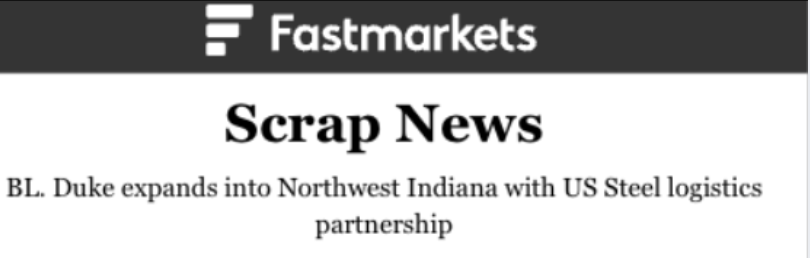
Learn More

Learn More

Learn More
Chicago’s Non-Ferrous Scrap Market
Aluminum. Aluminum scrap pricing has remained mostly flat to slightly weaker as earlier market momentum cooled. While LME aluminum remains significantly elevated year over year, secondary scrap markets have not fully kept pace, creating continued margin pressure for processors. Domestic supply remains steady, while demand has been stable but measured. Despite recent softness, the aluminum outlook remains cautiously bullish as elevated primary pricing continues to provide underlying support.
Stainless Steel. Stainless scrap pricing has remained largely flat, with nickel continuing to trade in a relatively stable range. Global nickel oversupply is limiting upside momentum, although periodic supply concerns are creating short-term volatility. Domestic scrap availability remains steady, while mill demand continues to improve gradually alongside broader manufacturing activity. For now, the stainless market is expected to remain mostly stable.

Copper. Copper remains one of the strongest and most volatile scrap markets, with pricing still elevated year over year. Scrap pricing continues to closely track COMEX and LME movements, creating continued day-to-day volatility. Long-term supply fundamentals remain supportive, while export demand continues to provide key market support.












Let’s Connect
We’ll work hard to earn your business — and even harder to keep it.