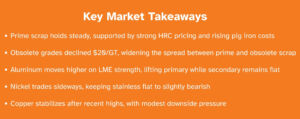
The domestic ferrous scrap market has settled soft-sideways, with a widening divide between prime and obsolete grades. Despite early expectations for broader declines, rising pig iron costs, improving export activity, and stronger finished steel pricing have helped support the market.
Non-ferrous markets remain mixed, with aluminum strength offsetting softer sentiment in stainless and copper.
Chicago’s Ferrous Scrap Market
 Prime Grades. In Chicago, April pricing reflects the broader national trend, with a clear divide between prime and obsolete grades. Prime scrap held flat for the second consecutive month, supported by strong domestic steel prices and elevated pig iron costs. With landed pig iron prices into the U.S. now estimated around $567 per tonne inclusive of tariffs, prime scrap remains competitively priced on a replacement basis, reinforcing demand for higher-yield materials. No. 1 Bundles and Busheling remain well positioned as mills continue to prioritize high-quality feedstock tied to finished steel production.
Obsolete Grades. Obsolete grades came under pressure, down $20 per gross ton. Improved scrap flows and reduced buying activity tied to mill outages allow buyers to push shred, turnings and cut grades lower.
“The fact that prime grades are holding sideways right now is unprecedented,” said Lou Plucinski. “With the spread between busheling and HRC sitting above $600, the fundamentals point to stronger support for prime grades than what we’re seeing today.”
Expanding into Northwest Indiana
 As market conditions evolve, access to key regions is more important than ever. With our expansion into Portage, IN, BL Duke is strengthening its presence in one of the Midwest’s most critical steel and manufacturing corridors—allowing us to better support customers across Northwest Indiana and the greater Midwest. [Learn More]
 Mill Outages & Improving Flows. On the domestic side, several planned outages are impacting demand. Downtime at key Midwest mills—including a blast furnace outage at U.S. Steel’s Gary Works, a one-week outage at NLMK in Portage, and downtime at Nucor’s Kankakee facility—is temporarily reducing scrap consumption, with many outages lasting 5–10 days and overlapping into April.
At the same time, warmer weather is improving scrap flows across the Midwest, easing earlier tightness. This combination is allowing mills to apply targeted pressure on obsolete grades, particularly shredded scrap, while maintaining steady buying programs for prime materials.
Chicago’s Non-Ferrous Scrap Market
Aluminum. LME aluminum has risen more than 11% over the past month, supporting primary scrap pricing, while secondary grades remain relatively flat—creating a clear disconnect in the market. Recent geopolitical disruptions, including smelter attacks in the Middle East, have contributed to the move. If tensions involving Iran persist, bullish sentiment could continue. That said, if manufacturing activity softens, aluminum scrap pricing may level off despite strength in the index.
Stainless Steel. The nickel market has traded sideways over the past 30 days, struggling to break above the $8.00/lb level. As a result, stainless scrap remains sideways to slightly bearish. At the same time, improving weather is increasing scrap flows, loosening supply and giving buyers more leverage—reducing urgency and applying mild downward pressure on pricing.
Copper. Copper has lost momentum following its earlier rally and is beginning to stabilize at historically strong levels. The previous run-up—driven

by supply disruptions, U.S. stockpiling, and tariff speculation—has largely played out. In the near term, copper is expected to face modest downward pressure, with potential declines of 1– 2% as the market searches for direction.